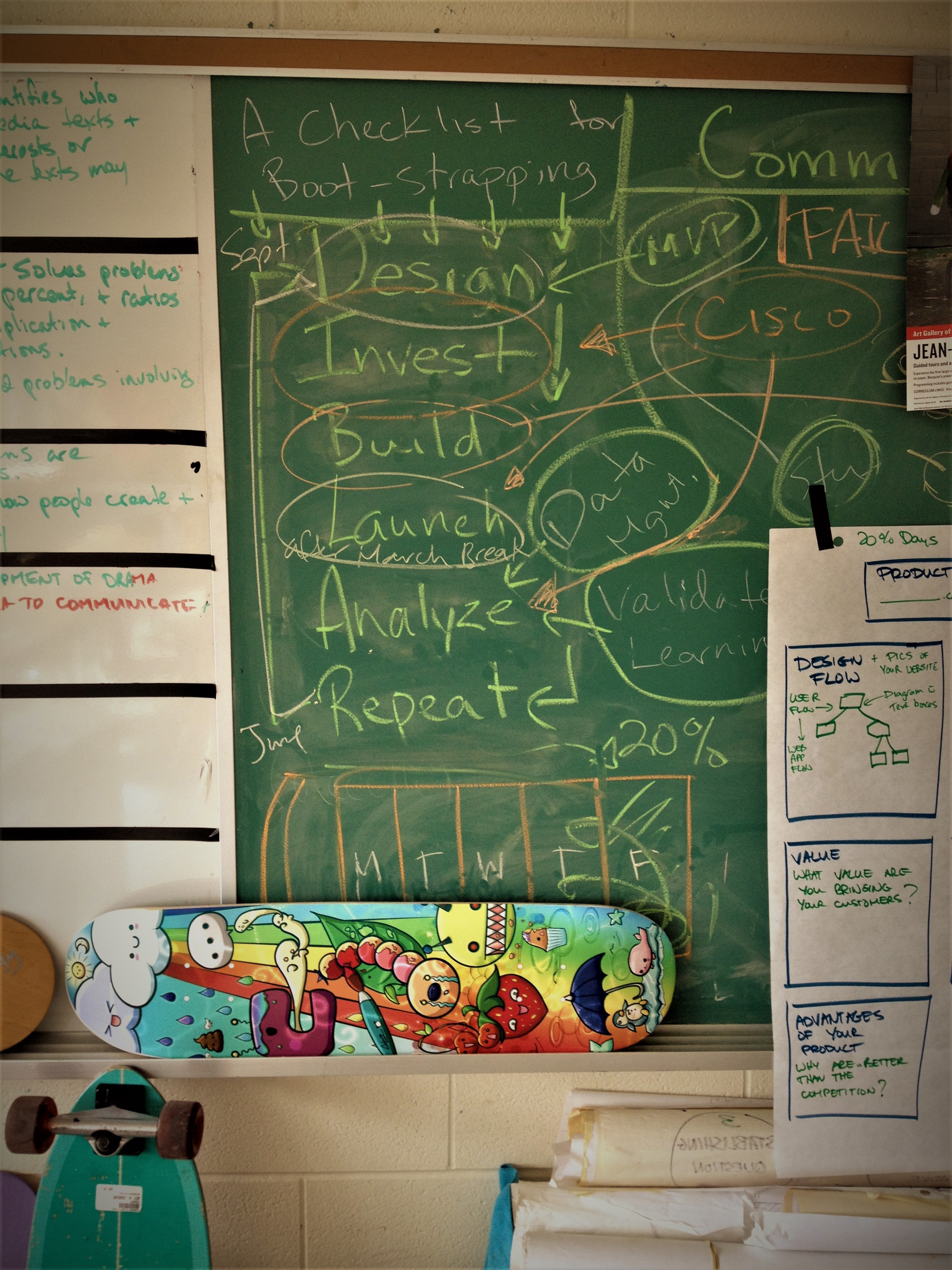
Ten years ago this December, I stood in Philadelphia at the Reimagine Education Awards and presented The Bootstrapping Checklist, a free Creative Commons resource for guided iterative inquiry in the classroom.
The idea was simple. Entrepreneurial skills like resilience, focus, commitment, reflection, and respectful collaboration grow through practice, and every student can build them. Kaizen, the Japanese practice of continuous improvement, sits at the centre, and validated data guides each design decision.
A decade later, my Grade 7 students still love it. They use it to plan their projects, work through tough team meetings, and speak to each other like professionals pursuing a shared vision. The tools in their hands have changed a great deal since 2016. The checklist has held up because it teaches process, and process carries over to every new tool that arrives.
Keeping it open made that possible. Thank you to everyone who has helped make it better. It remains free for anyone to use. To every student who has worked through it, your passion are the reason it exists.
P.S. Innovation in Education has been shortlisted in the Nurturing Employability category for the 2026 QS Reimagine Education Awards.
What if students could hold real ownership of their work, or “NFTing” their effort, and what if that ownership could stimulate a local economy using the human capital already in any classroom, school, and neighborhood? Ownership of a student’s intellectual property is the precondition for a market to exist around their work at all. Without it, a talented kid in a struggling neighbourhood can stay invisible, no matter what they build.
Innovation in Education have been working with an outstanding global team including https://thesolo.network/ to develop Lern2Ern.com and this week, Lern2Ern placed in the top 25 percent of over 2,200 projects, reviewed by more than a thousand judges. We’re looking for institutional partners to pilot this at scale, and investment to build out the pathways already in motion. We especially want K-20 in this room. If blockchain-verified ownership is going to become real infrastructure for global cooperation in #education, universities and school districts globally should be building it with us, not adopting it later.
The MIT AI Committee released its report on August 28, 2026. The finding that matters most for teachers is that AI can already produce credible responses to almost any written assignment, including essays, math problems, and design work. The question the report does not answer is what to do about it in a classroom today.
There are three sprints. Each one is a standalone tool. Each one is free. Each one produces a body of student work that AI cannot replicate, because the evidence is hand-made, documented over time, and confirmed in a live interview or a public launch. When the sprint is done, teachers submit the work to Innovation in Education and we upload verified badges to the Lern2ern® platform. The work belongs to the students, not the school and not us.
Here is what each sprint builds.
The Rule-Maker’s Sprint (1,000 XP, 6 badges) runs in the first two weeks of school and is designed for Visual Arts classrooms at middle and high school level. Students study seven artists who set rules for themselves — Andy Goldsworthy, Deborah Butterfield, Kehinde Wiley, Christi Belcourt, Norval Morrisseau, Agnes Martin, Yayoi Kusama* your choice — then set their own rules and make a series of three to five connected artworks that follow them. The sprint closes with a 12-to-15-minute Lerner Interview. The question that confirms the final badge is the same one every creative professional faces eventually: show me the sketch that became this. XP is awarded against the Biggs and Collis SOLO Taxonomy, with the Critical Analysis Badge and the Rule-Maker Capstone Badge together worth 600 XP at the Relational and Extended Abstract levels.
The Graphic Narrative Sprint (2,240 XP, 7 badges) runs across the first semester for Visual Arts and Language Arts classrooms. The principle at the centre of it is A + B + C = D. D belongs to you. Students research a minimum of five existing heroes and five existing villains from diverse sources — comics, mythology, film, animation, history — and synthesise two original characters from that research. The finished characters must be traceable to the research templates in the sketchbook. AI can generate any A, B, or C. Only the student can produce D, because D is the record of choices made over months and confirmed at the badge interview. Semester 1 is fully analog. No AI tools until Semester 2, when students direct AI production tools as authors rather than passengers, with every AI output traceable to a prior hand-drawn original.
The A/B Test Cycle (1,600 XP, 5 badges) is the social-entrepreneurship sprint and it runs independently of the other two. It follows the full entrepreneurship cycle from user persona to public launch to data-based decision. Students build a persona grounded in a specific real person’s real pain, test two versions of a solution with a real crowd under simultaneous conditions, and make a decision grounded in what the data actually says. The Analyse badge (400 XP) is awarded at Extended Abstract level — the highest SOLO level — because making an honest data-based decision and presenting the full project arc to an external audience is genuinely demanding work.
A student who completes all three sprints earns 4,840 XP across 18 badges. That record covers Visual Arts, Language Arts (Media Literacy), Social-Entrepreneurship, and, where the math component is included, mathematical reasoning and data literacy. It is built from sketchbooks, research templates, character sheets, prototypes, feedback forms, launch records, math notebooks, and oral interviews. It is not a grade. It is evidence of what the student can actually do, confirmed by a person, traceable to artifacts, and owned by the student permanently.
The model is straightforward. The sprint tools are free. Teachers download the documentation, run the sprint, and collect the evidence. When the sprint closes, they submit the XP Trackers, sketchbook photographs, interview notes, and launch records to Innovation in Education. We review the work against the Artifact Integrity Test and upload verified badges to the Lern2ern® platform. The badge upload and bespoke customer service operate on a subscription basis. One session of teacher training is all that is needed to launch any of the three sprints.
Bespoke customer service means a person, not a help desk. It means someone who knows the sprint, knows the rubric, and can answer a question about a specific student’s sketchbook.
If you want to run one of these sprints with your class, the starting point is a conversation. Email info@iiedu.ca with your name, school, and which sprint you want to start with. We will send the full documentation and confirm training.
The tools are free. The thinking is the students’. The badge is proof.