In March of 2002, I submitted my LLM thesis at the tail end of what felt like the internet’s wild adolescence. Napster had just been shut down. The DMCA was four years old. The EU Copyright Directive had barely dried on the page. The question I spent 22,000 words trying to answer was this: as digital technology makes it easier than ever to access and share knowledge, who actually owns it — and who gets to decide who can use it?
I argued that the wave of anti-circumvention legislation sweeping through the US, EU, and UK was tipping the balance dangerously in favour of content owners, quietly eroding the public’s right to access and use knowledge freely. I called it the impoverishment of the public domain. I worried about a future where everything we read, watch, or listen to is gated behind a toll. A pay-per-view world.
Reading it now is a strange experience. On one hand, it feels dated — the anxieties of 2002 were shaped by dialup modems, CD burners, and a music industry still reeling from the shock of digital distribution. On the other hand, it reads like a warning that wasn’t heeded. The impoverishment I worried about didn’t just happen to consumers of commercial media. It happened inside our schools.
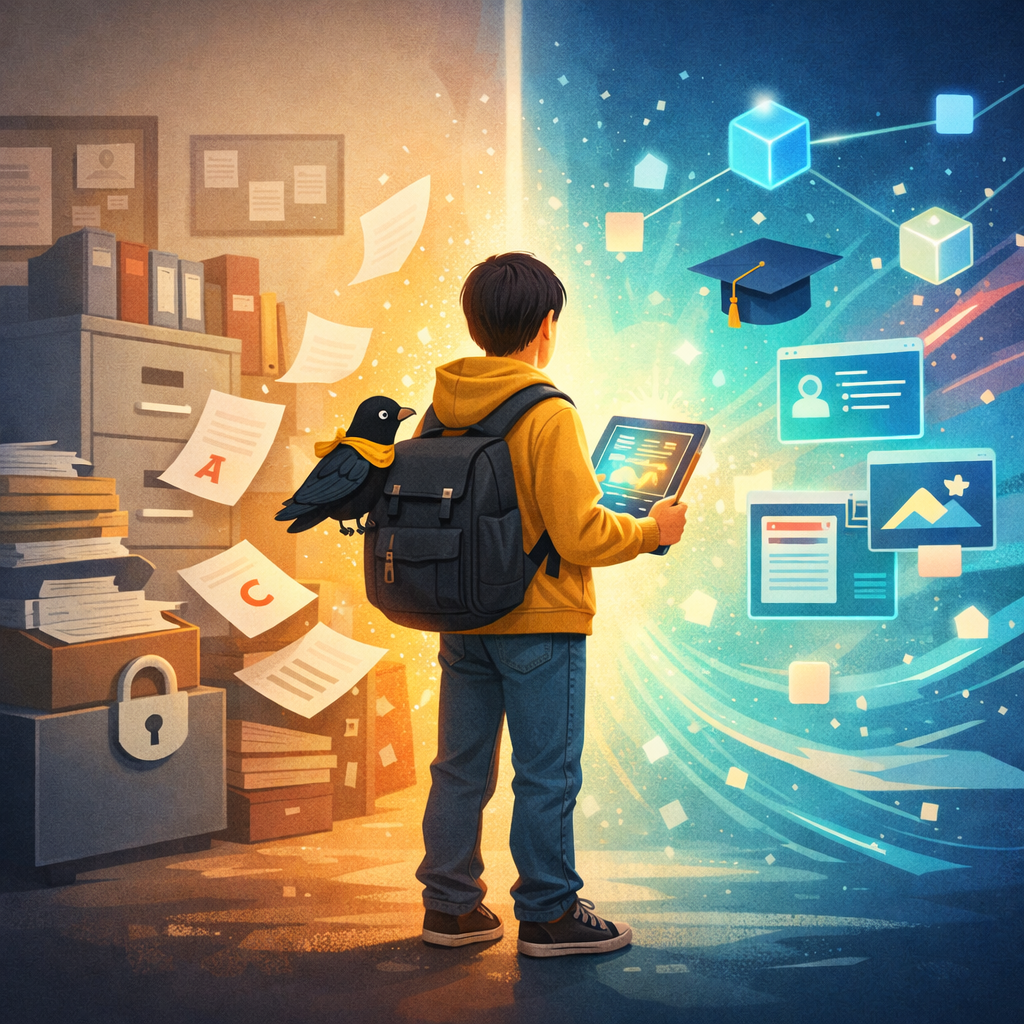
Somewhere along the way we built an education system where students create enormous amounts of intellectual and creative work, and own almost none of it. Essays, projects, designs, code, research, portfolios: produced by young people, absorbed into institutional systems, and then lost the moment they graduate. The very people we claim to be educating — preparing for careers, for life, for contribution — leave with credentials on paper but no verifiable proof of the thinking and making they’ve actually done.
I saw kids pour genuine effort, creativity, and original thinking into projects that would be graded, filed, and forgotten. I saw the gap between what they were actually capable of — their real intellectual output — and what the system captured and gave back to them. A letter grade is not a portfolio. A report card is not a career asset. And a school-managed platform is not the same as owning your own work.
My 2002 thesis argued that the fair dealing doctrine — the public’s right to use knowledge — was being chipped away by technology and law working in concert. What I didn’t see then, but understand now, is that the same dynamic was playing out inside education. Students were producing knowledge, and institutions were, by default, holding it.
Lern2ern gives students 100% intellectual property ownership of everything they create. Their work is blockchain-verified, meaning it’s tamper-proof, portable, and permanent — a credential that lives with them, not with a school server. It’s built on the principle that if we genuinely believe students are producers of knowledge and not just consumers of it, then we have to treat their work as something that actually belongs to them.
This isn’t just an ethical position. It’s a practical one. In an economy where skills and proof-of-work matter more than ever, students — especially those from under-resourced communities — need assets they can actually use. A blockchain-verified portfolio of real work, built across years of learning, is more honest and more useful than a transcript.
But I also want to be clear about what this is really about. It’s not just about career outcomes. It’s about dignity. When we tell a child that their work matters, and then build a system that treats it as institutional property, we are saying something about whose knowledge counts and who gets to control it. That’s the same question my 2002 thesis was asking, just in a different room.
I’ve been shortlisted for the 2025 QS Reimagine Education Awards in the Nurturing Employability category. When I think about what I’d want people to take away from Lern2ern, it’s not the blockchain piece — though that’s important. It’s the underlying conviction: that students are not raw material to be processed by an educational system, but creators whose intellectual output has real value, and who deserve to own it.
Twenty-three years ago I wrote about the right to access knowledge. Today I’m building a system around the right to own it.
Turns out I’ve been working on the same problem the whole time.
Rich Baxter is a Grade 7 teacher at John McCrae Public School (TDSB), Founder & CEO of Innovation in Education, and creator of the Lern2ern platform. He is shortlisted for the 2025 QS Reimagine Education Award in Nurturing Employability.

#Lern2Ern #StudentOwnership #FutureOfEducation #SkillsBasedLearning #DigitalCredentials #EducationInnovation #OwnYourLearning #StudentCreators #EducationTransformation #ProofOfWork #Web3 #AI #Blockchain
 Innovation in Education